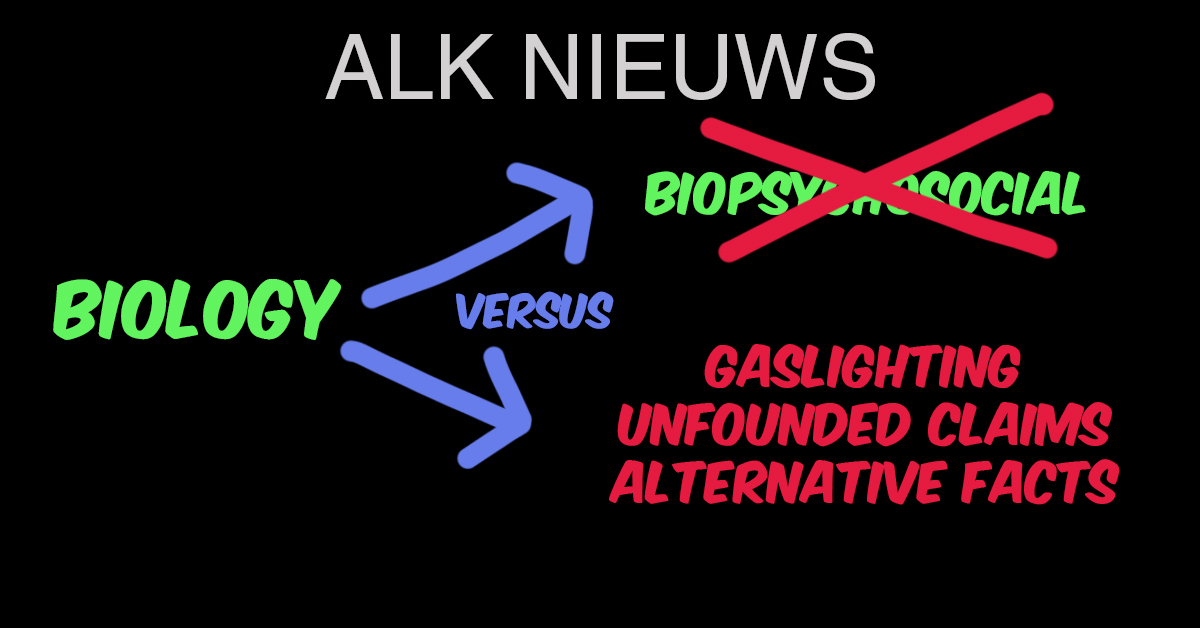
An interesting article in ALK Nieuws, but unfortunately one based on a misleading false balance. It suggests that the way Long Covid is explained, either as purely biological or biopsychosocial (BPS), influences expectations about recovery and treatment. However, this creates the impression that biology versus BPS is the key distinction, when that is not the actual issue.
The French authors of the first article are known for downplaying, denying, or distorting the biological nature of the illness. They make unsupported claims that align with the old CBT model for CFS, a model that is fortunately being increasingly abandoned internationally.
In the explanatory video referenced by the French authors, it is stated, among other things 1, 2:
“Fear of resuming physical activity after the initial infection period further fuels a vicious cycle of symptom maintenance as a result of exercise-induced deconditioning.”
This is also similar to what Ranque et al. previously wrote to Dutch researchers Appelman et al. 2024 after they had found muscle necrosis in Long Covid patients following exertion.
Appelman et al. not only convincingly dismantled these deconditioning claims in their response, but later published an important study comparing the muscles of healthy participants after 60 days of bed rest with those of people with Long Covid and ME/CFS. They found that the observed abnormalities could not be fully explained by deconditioning.
This is consistent with other studies that also refute the deconditioning hypothesis.
Another claim made in the video states:
“Finally, social mechanisms are also involved, particularly alarming information spread through the media and social networks.”
There is also no convincing evidence for this claim in the Netherlands. Dutch researchers Ballering et al. (2023) found no clear relationship between a nocebo effect, symptoms, and the extent to which Long Covid was discussed in the media.
The video contains several more unsupported assertions.
I previously wrote a response to Deurman’s publication. Interviewing only recovered patients tells us nothing about the effect of the treatment itself. Most patients with a PAIS who remain ill for long periods have often already undergone similar treatments or programmes without success and with iatrogenic harm. Moreover, when such interventions are studied in research settings, they do not demonstrate objective improvement, just as CBT and GET have failed to do. Mind-body and brain retraining interventions have been promoted and studied for many years, long before the pandemic, and are not new.
More importantly, Deurman et al. offer explanations that appear to reinterpret patients’ experiences of illness in a way that yet again strongly resembles both the old CBT model and the approach taken by Ranque et al. PEM is not discussed at all in Deurman’s publication. By ignoring post-exertional malaise (PEM), such explanations based on gradually increasing activity may even be harmful.
The ALK News article attempts to use this literature to explain the effects of a BPS explanation versus a purely biological explanation. In reality, however, the issue is not biology versus BPS. It is biology versus denial, distortion, and gaslighting based on unsupported claims.
That does not mean attention to psycho-social factors is unimportant. It does mean that patients should not be taught explanations that do not align with the scientific understanding of the illness and that may expose them to iatrogenic harm.
We do see some people improve after these interventions. However, we also see people improve or recover after homeopathy or other alternative treatments. Improvement can occur for many reasons that say little about the specific effects of the intervention itself, let alone whether they are the best or safest option.1, 2
With CBT and GET, we have seen that deliberately increasing activity can cause harm. For patients with PEM, this may even result in lasting deterioration. In a study by Holtzman et al. 2019, 67.1% of participants reported permanent worsening after a PEM crash. In my view, this is something we should try to prevent as much as possible. First, do no harm. Right?
Attention to psycho-social factors also does not mean that patients should be taught to gradually abandon PEM management, orthostatic intolerance (OI) management, or pacing once they begin to feel “safe” again.
As with other chronic illnesses, around a quarter of patients have psychiatric comorbidities. Of course, these individuals may experience additional anxiety or uncertainty. However, this does not alter the existence of PEM, OI, and other biological phenomena, nor does it justify explanations based on unsupported or potentially harmful assumptions.
In other words, we do not need to gaslight patients with this kind of literature. A BPS approach simply means that psychological and social factors are considered alongside biological factors. As we can see here, such an approach can be fully grounded in the biological insights that have emerged from biomedical research. This will also prevent patients from feeling justifiably offended. It does not require distorting the reality of the illness or the limitations patients experience. Yet this is precisely what the publications cited by ALK Nieuws do.
This false balance is similar to what we previously saw with CBT and GET. It also allows criticism of CBT, GET, or mind-body approaches to be presented as criticism of psychology, psychotherapy, or the role of psycho-social factors in general, when in reality the criticism concerns explanatory models that do not align with biomedical scientific evidence.
In itself, it is positive that ALK Nieuws acknowledges that some patients may relate more strongly to a biological explanation, especially when they have spent years unsuccessfully searching for answers within the psycho-social framework. That has also been my experience, and in light of previous publications, it represents a small step forward.
However, it does not change the false balance between biology and BPS that the article creates. As a result, the article remains misleading and is more likely to obstruct appropriate care than contribute to it. This also applies to good and safe psycho-social support.
In that respect, ALK Nieuws still has a long way to go before it genuinely contributes to better care for people with a PAIS. That is disappointing, but unfortunately not surprising.